3 Key Takeaways:
- CNC machining delivers repeatable precision that hand-fitting and casting simply can’t match
- Crom USA uses CNC machining for every part it manufactures in Sacramento
- Tighter tolerances mean better fit, better function, and longer service life for every upgrade
Two parts can look identical. Same shape, same finish, same product name on the same product page. And one will fit perfectly — lock in, function exactly as intended, and stay that way over thousands of cycles. The other will have just enough play to wobble under recoil, enough dimensional variance to cause inconsistent function, and enough material softness to wear unevenly over its service life.
The difference, in most cases, is how they were made. And specifically, whether CNC machined gun parts were produced by a manufacturer who actually holds the tolerances that CNC machining makes possible — or by one that uses CNC as a marketing term attached to a manufacturing process that doesn’t produce the precision the term implies.
At Crom USA in Sacramento, CNC machining is the foundation of every part we produce. Not as a descriptor we apply to our products to make them sound more precise, but as the actual manufacturing method we use for every component in our lineup, calibrated and operated to produce the tolerances our designs require.
What Is CNC Machining and Why Does It Matter for Gun Parts?
CNC stands for Computer Numerical Control — a manufacturing process in which machine tools are guided by programmed computer instructions rather than by manual operator control. A CNC machining center receives a program that specifies exactly how the cutting tools move, at what speed, to what depth, along what path — and it executes those instructions with a consistency and precision that manual machining simply can’t replicate.
For gun parts, CNC machining matters for one fundamental reason: tolerances.
A tolerance is the permissible range of dimensional variation in a manufactured part. If a dimension is specified as 1.000 inches with a tolerance of ±0.001 inches, any measurement between 0.999 and 1.001 inches is within spec. The tighter the tolerance — the smaller the permitted range of variation — the more precisely the finished part conforms to the design specification.
Gun parts require tight tolerances because they have to fit into specific interfaces, operate within specific clearances, and interact with other components that also have dimensional specifications. When tolerances are too loose, parts wobble, don’t seat correctly, or don’t interact with mating components the way the design requires. When tolerances are held correctly, parts fit without forcing, operate smoothly, and maintain their performance characteristics over their service life.
CNC machining makes tight tolerance production repeatable. A well-programmed CNC operation on a well-calibrated machine holds the same tolerances on part 1 as on part 1,000. That repeatability is what makes CNC-machined gun parts reliable as a category — and it’s what separates manufacturers who use CNC as a genuine quality claim from those who use it as a marketing term.
What Happens When Gun Parts Don’t Hold Tolerance
The consequences of poor tolerance control in gun parts range from annoying to genuinely problematic, depending on the component involved.
Wobble and play: Rail adapters, muzzle devices, and other mounting components that are machined to loose tolerances introduce play into the interface. Under sustained fire, that play becomes movement — a mounted accessory that shifts with each round, or a muzzle device that rotates slightly and introduces asymmetrical blast patterns.
Function inconsistency: Operating components — extractors, firing pin assemblies, bolt components — that are machined to loose tolerances interact inconsistently with the other components they’re designed to work with. The result is variable function — cycles that feel different from each other, extraction that varies in feel and reliability, timing that changes as components wear.
Accelerated wear: When parts don’t fit with the precision the design calls for, the contact surfaces wear in ways and at rates that the design didn’t account for. A slightly loose extractor will wear on contact surfaces that a correctly fitted extractor wouldn’t stress — eventually wearing to the point of failure faster than a correctly fitted part would.
Zero drift: For any component that affects the alignment of mounted accessories — rail adapters, mounting hardware — dimensional imprecision that allows movement under recoil translates directly to zero drift. Your light or laser doesn’t stay where you zeroed it because the mount allows micro-movement that accumulates over a range session.
Crom USA’s CNC Machining Process in Sacramento
We run our CNC machining operations on modern, calibrated equipment in our Sacramento facility. The programs that drive our machining operations are developed to hold the tolerances our designs require — not to the tolerances that are convenient for high-volume production, but to the tolerances that produce the fit and function we’re designing for.
Our tooling is maintained to the standards that precision machining requires. We use appropriate cutting tools for the material and the dimensional requirements of each operation. We monitor our equipment calibration because calibration drift is how precision manufacturing loses its precision without obvious symptoms.
The result is CNC machined gun parts Sacramento that hold their specified tolerances consistently across production runs. Browse our full lineup in the shop and see the evidence of precision manufacturing in every product.
Crom USA’s CNC Machined Parts Lineup
Every part in our catalog represents CNC machining applied to a specific performance goal:
Eagle’s Talon Extractor — Precision Where Reliability Lives The extractor requires precise geometry to function reliably. The engagement surface that hooks the case rim has to be exactly the right depth to provide positive retention without binding during extraction. The spring tension interface has to be dimensioned correctly to provide the right extraction force. The body geometry has to interface correctly with the bolt assembly. All of these are tolerance-dependent dimensions that CNC machining holds consistently, producing an extractor that performs reliably from the first round to the thousandth.
Blast Can Muzzle — Thread Precision for Secure Attachment Thread precision is where CNC machining makes the most visible difference in muzzle devices. Threads machined to exact pitch and form fit correctly, torque to spec, and stay tight under sustained fire. Threads machined to loose tolerances strip, loosen, and create the safety and performance issues that plagued earlier generations of carelessly made muzzle devices. Our Blast Can Muzzle threads are machined to exact specifications for the PC carbine platform — clean installation, secure retention, reliable function.
1913 Picatinny Adapter — MIL-SPEC Dimensions Held Exactly The Picatinny rail specification is explicit — slot width, slot depth, cross-section profile, and rail geometry are all defined to specific dimensions. Our adapter is machined to those dimensions, not approximated to them. The result is an adapter that accepts any MIL-SPEC-compliant accessory with the zero-play fit the standard was designed to produce.
Where to Find CNC Machined Gun Parts Near You
For Sacramento-area shooters who want CNC machined gun parts from a manufacturer who can tell them specifically what tolerances they’re holding, Crom USA is the local answer. We’re not marketing CNC machining as a concept — we’re using it as a manufacturing method and producing the results that precision machining should produce.
If you’ve been searching for CNC machined gun parts near me from a manufacturer worth trusting, reach out through our contact page. We’re in Sacramento, we’re reachable, and we’re glad to talk through what makes our manufacturing process different from the alternatives.
How to Tell If a Gun Part Was Actually CNC Machined
Not every part marketed as “CNC machined” is produced to the standard that phrase implies. Here’s how to evaluate the claim:
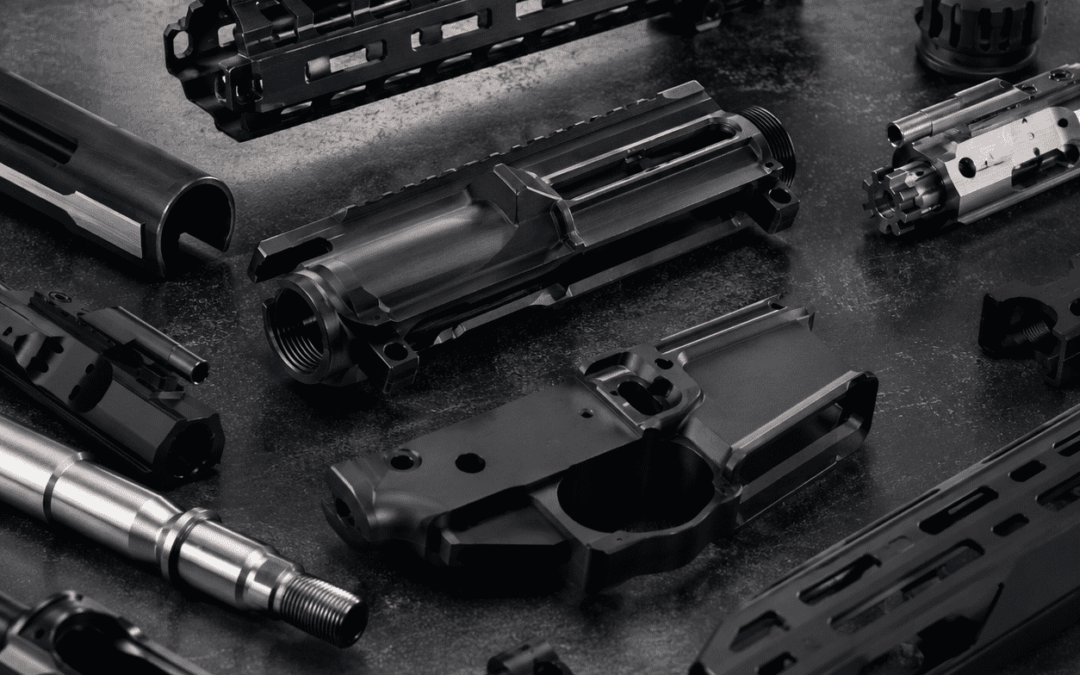
Look at the machined surfaces: Genuine precision CNC machining produces clean, consistent surface finishes with clearly defined features. Edges are sharp. Radii are uniform. Machining marks, when visible, are consistent in spacing and depth. Parts that were cast and then touched up on a CNC machine look different from parts that were machined from billet — the underlying surface character reflects the casting process regardless of any subsequent machining.
Check the threads: Thread quality is a visible indicator of machining precision. Threads that were cut on calibrated CNC equipment have consistent pitch, consistent form, and clean crests and roots. Threads that were tapped with lower-precision equipment or produced in a less controlled process show visible irregularities under close inspection.
Ask about tolerances: A manufacturer confident in their CNC machining will give you specific tolerance information for the critical dimensions of their parts. Vague answers — “precision machined” or “tight tolerances” without numbers — suggest the manufacturer either doesn’t know their tolerances or doesn’t want to disclose them.
Consider the price in context: CNC machining on calibrated equipment from quality billet material has a cost floor. Parts priced significantly below that floor were made differently than their marketing suggests.
Precision-Built. Sacramento-Made. Crom USA.
Every part that leaves our Sacramento facility has been CNC machined to the tolerances our designs require. That precision shows up in fit, function, and longevity — the three outcomes that precision manufacturing produces consistently and that careless manufacturing consistently fails to deliver.
Browse our full lineup in the shop to see what precision CNC machining looks like in practice. Or reach out through our contact page if you’d like to discuss your specific build and what our parts would contribute to it.
FAQs
Q: What machines does Crom USA use for CNC machining? A: We run modern CNC machining centers in our Sacramento facility. For specific equipment questions, reach out through our contact page — we’re transparent about our manufacturing process.
Q: How do CNC machined gun parts compare to forged or cast alternatives? A: CNC machining and forging serve different purposes — forging produces excellent grain structure through material compression, while CNC machining produces precise geometry through material removal. For firearm components where dimensional precision is the primary requirement, CNC machining from quality billet stock provides the combination of structural integrity and dimensional accuracy the application needs. Cast parts generally perform below both forged and CNC machined alternatives in strength and dimensional consistency for demanding firearm applications.
Q: Do CNC machined gun parts require break-in periods? A: Generally, no — properly machined parts to correct tolerances function correctly from the first cycle. A “break-in” period is often described for parts that need initial wear to bring dimensions into operating range — which is a characteristic of parts machined to looser tolerances, not of precision CNC parts.