
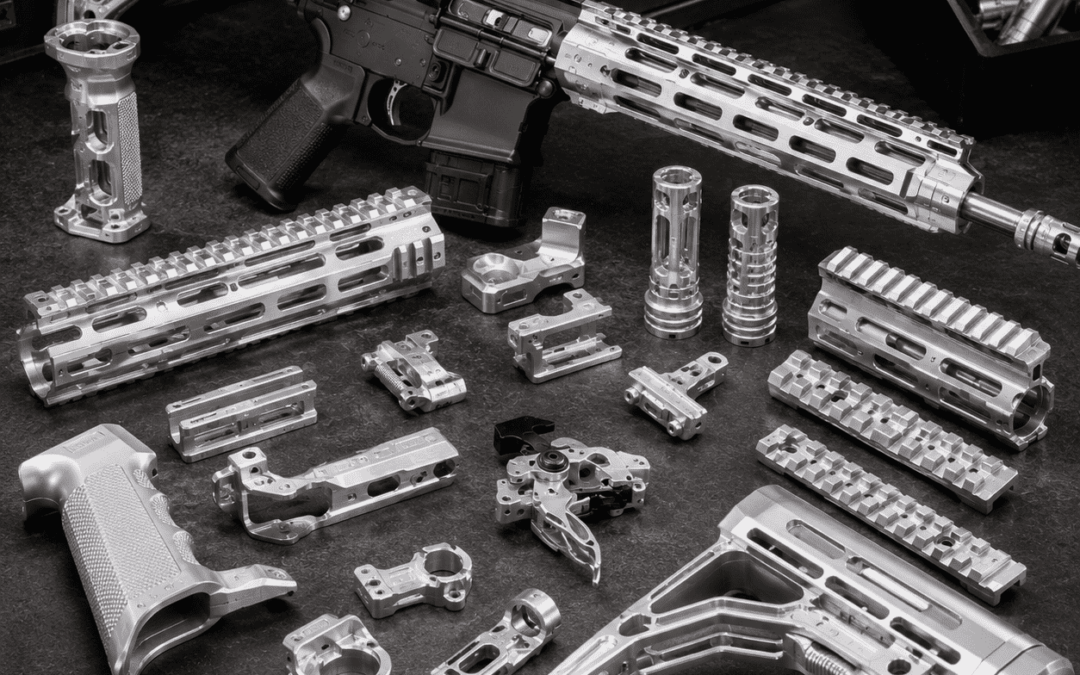
3 Key Takeaways:
- Billet aluminum offers superior strength, dimensional precision, and finish quality over cast or stamped alternatives
- Every Crom USA firearm part is CNC-machined from billet aluminum for consistent performance
- Sacramento-manufactured billet aluminum parts from Crom USA are built to spec and built to last
When serious shooters talk about quality firearm parts, the conversation eventually comes back to materials. Not as an abstract discussion of metallurgy, but as a practical question with real performance implications: what is this part made from, and does that material hold up to the demands of the application?
Billet aluminum firearm parts represent a specific answer to that question — one that the firearms accessories industry has largely converged on for high-quality components. The reasons aren’t complicated, but they’re worth understanding, because the difference between billet aluminum and the alternatives shows up in measurable performance outcomes over the service life of the part.
At Crom USA in Sacramento, billet aluminum isn’t a marketing descriptor. It’s our manufacturing baseline. Every part we machine starts with billet stock, and our CNC process gives us the precision to turn that material into components that hold spec across every production run.
What Is Billet Aluminum and Why Does It Matter for Firearm Parts?
Billet aluminum refers to aluminum that has been extruded or rolled into a solid block or bar — a continuous, uniform material without voids, seams, or structural irregularities. The manufacturing process for billet aluminum produces a material with consistent grain structure throughout the cross-section, which translates directly into consistent mechanical properties throughout the finished part.
That consistency is what makes billet aluminum the preferred material for precision firearm components.
Grain structure: The continuous, uniform grain structure of billet aluminum means the material has consistent strength and hardness at every point in the finished part. There are no weak spots created by porosity, inclusions, or grain discontinuities from the casting process.
Dimensional stability: Billet aluminum maintains its dimensions under thermal cycling and mechanical stress better than cast aluminum. For firearm components that experience repeated heating from sustained fire and repeated stress from cycling, dimensional stability determines how well the part maintains its specified fit and function over time.
Machinability: Billet aluminum machines cleanly and precisely, allowing CNC operations to hold tight tolerances without the surface irregularities, porosity, or material inconsistency that make holding tolerances difficult with cast material.
Surface quality: Machined surfaces on billet aluminum have a quality and uniformity that cast surfaces — even after finishing treatments — can’t match. The finish you see on a quality billet aluminum part comes from the machining process, not from a coating applied to cover a rough cast surface.
Why Cast and Stamped Parts Fall Short for High-Demand Applications
Understanding what makes billet aluminum better requires understanding what the alternatives are and why they underperform in demanding applications.
Cast aluminum is produced by melting aluminum alloy and pouring it into a mold. The casting process introduces two fundamental quality limitations that affect the finished part. First, voids and porosity are common in cast aluminum — bubbles and structural discontinuities that create weak spots in the material. Second, grain structure in cast aluminum is irregular and unpredictable, which means mechanical properties vary throughout the part in ways that are difficult to predict or control.
Cast aluminum is less expensive to process than billet because you’re not machining away large amounts of material from solid stock — you’re pouring material into approximately the shape you want and then finishing. That cost savings comes directly at the expense of the structural consistency that demanding applications require.
Stamped parts are formed by pressing metal stock between dies — a high-speed, high-volume process that works well for simple shapes but introduces dimensional variability and residual stress into the material. For complex, precision-dimensioned firearm components, stamping doesn’t provide the dimensional control that the application demands.
Both alternatives have legitimate applications in product manufacturing. Neither is appropriate as the material choice for firearm components where dimensional precision, structural consistency, and long-term durability matter.
Crom USA’s Billet Aluminum Manufacturing Process
Our manufacturing process begins with billet stock selected to the alloy specification our designs call for — a hard, dimensionally stable alloy appropriate for the stress conditions firearm components experience. That material goes directly to our CNC equipment, where it’s machined to the exact specifications our designs require.
The CNC machining process is where billet aluminum’s material properties translate into finished part quality. Because the material is dimensionally consistent throughout, we can hold tight tolerances reliably across production runs. Because the grain structure is uniform, the machined surfaces are clean and consistent. Because the material is hard and stable, the finished part maintains its dimensions under the thermal and mechanical stress of firearm use.
If you’re ready to see what properly made billet aluminum firearm parts look like in Sacramento, our full product lineup is available through our online store.
Crom USA’s Billet Aluminum Firearm Parts Lineup
Every part in our catalog reflects the same material standard and manufacturing process:
Eagle’s Talon Extractor — Billet Precision for the Most Stressed Component The extractor is subjected to repeated, significant mechanical stress with every round cycled through the platform. The case head engagement, the extraction force, the release — each cycle puts real load on the extractor geometry. A part made from cast aluminum with irregular grain structure will show wear in the geometry that matters most faster than a billet part machined from consistent, hard material. Our Eagle’s Talon Extractor is machined from billet aluminum to a geometry that performs more reliably than factory spec and holds that performance across the service life of the part.
Blast Can Muzzle — Billet Durability for Muzzle Applications The muzzle device environment involves high-temperature gas exposure, mechanical thread stress from installation and removal, and the recoil forces transmitted through the muzzle attachment. Billet aluminum handles all three of these conditions better than cast alternatives — better dimensional stability under thermal cycling, better thread integrity under torque, better structural integrity under recoil load. Our Blast Can Muzzle is machined from billet stock to deliver the functional and durability performance the muzzle application requires.
1913 Picatinny Adapter — Billet Precision for Zero-Play Rail Interfaces The rail adapter is where billet aluminum’s dimensional precision advantage is most directly visible in performance. Rail slot dimensions, cross-section profile, mounting interface geometry — all of these need to be held to tight tolerances to produce a zero-play fit with rail-mounted accessories. Cast aluminum’s dimensional variability makes holding these tolerances across a production run unreliable. Billet aluminum machined on CNC equipment holds them consistently. That’s the difference between an adapter that produces zero-play fit and one that has a little wobble.
Finding Billet Aluminum Firearm Parts Near You
For Sacramento-area shooters looking for billet aluminum firearm parts from a manufacturer who machines them locally, Crom USA is the direct source. We don’t retail other manufacturers’ products alongside our own — everything we sell, we made.
That local manufacturing means we can speak with precision about the material and process behind every part we sell. If you’ve been searching for billet aluminum firearm parts near me and want to connect with the manufacturer directly, reach out through our contact page.
How to Identify True Billet Aluminum Parts When Shopping
The term “billet” gets applied to parts that weren’t made from billet stock, which means buyers need to know how to distinguish genuine billet construction from marketing use of the term.
Look for machining evidence: Genuine billet aluminum parts show the evidence of CNC machining — clean, sharp machined surfaces, consistent cutting marks, precisely defined edges and radii. Cast parts, even when finished, have a different surface character — smoother in an uneven way, with rounder edges that come from the casting process rather than the machining process.
Check for uniform surface finish: Billet aluminum machined surfaces have a consistent, uniform quality across the part. Cast surfaces that have been finished often show variation in texture that reflects the underlying cast surface condition.
Ask for material specification: A manufacturer confident in their billet aluminum construction can tell you specifically what alloy designation they’re using. “Billet aluminum” without a specific alloy designation is less informative than “6061-T6 billet aluminum” or a comparable specific description.
Weight and feel: Billet aluminum parts typically feel denser and more solid than cast parts of similar size because they don’t have the internal voids that casting processes introduce. This is a qualitative assessment, not a definitive test, but experienced shooters often note the difference.
Upgrade to Billet. Upgrade to Crom USA.
Every part in the Crom USA lineup is built from billet aluminum, machined in Sacramento to the tolerances that make a real performance difference. If you’re putting quality accessories on a platform you depend on, the material choice matters — and billet aluminum from a manufacturer who knows how to machine it is the right choice.
Browse our shop to see the full lineup, or reach out through our contact page with questions about your build.
FAQs
Q: What grade of aluminum does Crom USA use for its billet parts? A: We use high-grade billet aluminum appropriate for the mechanical demands of firearm component applications. For specific alloy and temper information for individual products, contact us directly — we’re transparent about our material specifications.
Q: Are billet aluminum parts stronger than factory OEM parts? A: In most cases, yes — particularly when OEM parts are cast or made from softer aluminum alloys to meet price targets. Billet aluminum machined to the right specification has higher yield strength and better dimensional stability than cast aluminum of equivalent alloy. The specific comparison depends on the OEM part’s material specification, but billet from a quality manufacturer typically outperforms cast OEM components in demanding applications.
Q: How do billet aluminum firearm parts hold up against corrosion? A: Aluminum naturally forms a protective oxide layer that provides good corrosion resistance. Our parts are additionally finished to enhance that protection. For specific finish and corrosion resistance details for individual products, check the product listings or contact us.