
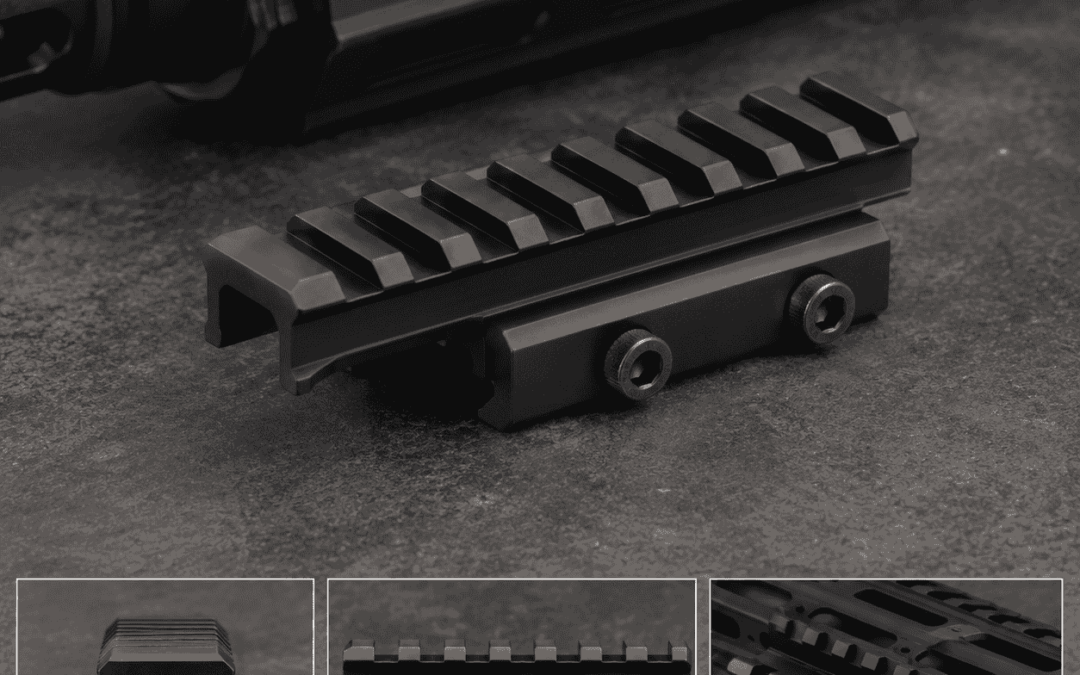
3 Key Takeaways:
- The 1913 Picatinny rail system is the industry standard for mounting accessories — your adapter needs to match that standard exactly
- Crom USA’s 1913 Picatinny Adapter is CNC machined from billet aluminum for a zero-play, rock-solid fit
- Sacramento shooters and online buyers trust Crom USA for precision-made adapter solutions
There’s a specific kind of frustration that comes from building a firearm the right way — quality optic, premium weapon light, properly specified laser — and then discovering that a substandard rail adapter is the weak link in the entire system. Your accessory drifts under recoil. Your zero shifts after a hundred rounds. The wobble you can feel in your hand becomes a function and accuracy problem downrange.
That failure point is exactly what the 1913 Picatinny Adapter from Crom USA is designed to eliminate. We machine it in Sacramento from billet aluminum, hold it to exact MIL-SPEC rail dimensions, and build it to the standard that your mounted accessories deserve — which means no play, no drift, and no compromises on what your rail system is supposed to deliver.
What Is a 1913 Picatinny Adapter and What Does It Do?
The MIL-STD-1913 rail — commonly called the Picatinny rail — is a standardized mounting interface developed for military firearms to provide a universal system for attaching accessories. The “1913” designation refers to the MIL-STD-1913 specification that defines the exact dimensions of the rail profile, slot spacing, and cross-section geometry.
When a firearm or accessory mount has a Picatinny-compatible slot or interface, any accessory built to the same MIL-STD-1913 specification can attach to it and lock down securely. That universality is the point — one standard that works across thousands of accessories from hundreds of manufacturers, with predictable fit and function every time.
A 1913 Picatinny Adapter serves a specific function: it takes a platform that doesn’t have a native Picatinny rail interface and adds one, enabling the shooter to run any standard rail-compatible accessory on a platform that wasn’t originally configured for it. For PC carbine shooters who want to run a weapon light, laser designator, foregrip, or bipod, the adapter is what makes that possible without requiring permanent modifications to the firearm.
The quality of the adapter determines the quality of the entire accessory mounting system. An adapter machined to exact MIL-SPEC rail dimensions produces a mounting surface that accepts accessories with the fit and security the standard was designed to provide. An adapter machined to looser tolerances produces wobble — even fractions of a millimeter of play translate to visible movement in a mounted accessory and measurable shift in point of impact for zeroed accessories.
Why Adapter Quality Matters More Than Most Shooters Realize
The rail adapter is an easy upgrade to undervalue. It’s a simple-looking part. There are inexpensive versions available that technically install and technically hold accessories. For casual use on a range gun where zero consistency isn’t critical, a cheap adapter might never cause a visible problem.
But the problems created by a poor-quality rail adapter compound as the demands on the system increase.
Point of impact shift: A zeroed optic or laser mounted to an adapter with even minor play will shift under recoil. After enough rounds, that shift accumulates into a zero that no longer reflects where the gun was zeroed. Competitive shooters experience this as unexplained groups opening up. Defensive shooters experience it as unreliability in the accessory they’re depending on.
Accessory loosening: Under sustained recoil, a mounting surface that doesn’t hold the accessory lockdown nut securely will allow the accessory to loosen over time. This is a known failure mode with cheap adapters — accessories that start the session tight end up with noticeable movement by the end.
Stress concentration: When a rail adapter flexes under load — because it was machined from soft material or to loose tolerances — it concentrates stress at the mounting interface. Over time, that stress cycle can damage either the adapter, the accessory mount, or both.
Structural failure: At the extreme end, adapters made from inadequately hard material can crack or deform under the sustained recoil of high-volume shooting. This is rare under light use but not rare in competition applications.
How Crom USA Machines the 1913 Picatinny Adapter
We machine our Picatinny adapter from billet aluminum — specifically chosen for its combination of strength, hardness, and dimensional stability after machining. The CNC machining process gives us exact control over every dimension that matters for MIL-STD-1913 compliance and performance.
Rail slot width and depth, cross-section profile, and mounting interface geometry are all held to the tolerances specified in the standard — not approximated to the tolerances that are easier to produce. That precision is what produces zero-play fit when an accessory is locked down on our adapter.
Find our full lineup, including the 1913 Picatinny Adapter Sacramento, available directly through our online store. Every product listing includes platform compatibility and installation details.
What You Can Mount With the Crom USA 1913 Picatinny Adapter
The MIL-STD-1913 standard covers an enormous range of accessories. Here’s a practical look at the most common use cases for a Picatinny adapter on a PC carbine build:
Weapon Lights: A light mounted to the Picatinny adapter provides positive illumination capability for low-light and no-light environments. For home defense PC carbines, this is one of the most important accessories you can add. The stability of the adapter determines whether your light maintains its alignment and zero across extended use.
Laser Designators: Red or IR laser designators provide quick target acquisition in training and tactical environments. Laser accuracy depends entirely on the stability of the mount — even micro-movement between the laser and the firearm creates significant downrange point-of-impact variance at defensive distances.
Foregrips: Vertical and angled foregrips mount directly to a Picatinny rail and improve control and stability during sustained fire. A stable adapter is the foundation for a foregrip that actually enhances control rather than introducing its own wobble.
Bipods: For shooters who use their PC carbine in precision applications, a bipod provides stable supported shooting positions. Picatinny-mounted bipods need a solid rail interface to provide the stability they’re designed for.
Finding a 1913 Picatinny Adapter Near You
For Sacramento-area shooters who want to support a local manufacturer and get the part directly from the people who made it, we’re here. There’s a real difference between buying from a local manufacturer and buying a commodity part through a marketplace, and it shows up in the quality of the part and in what happens when you have a question or a problem after the sale.
If you’ve been looking for a 1913 Picatinny Adapter near me from a source you can actually communicate with, reach out through our contact page. We’re a short conversation away.
Compatibility — Which Platforms Does the Crom USA Adapter Fit?
Our Picatinny adapter is designed primarily for the Ruger PC Carbine platform. The Ruger PC Carbine is the most popular 9mm carbine in the U.S. market, and it’s the platform we’ve designed our accessories around from the beginning.
Before ordering, verify that your specific PC carbine configuration is compatible with our adapter. The product page includes compatibility details, and we’re available to answer platform-specific questions directly if you’re running a less common configuration or variant.
The adapter is machined to exact MIL-STD-1913 rail dimensions, which means any accessory built to that standard — which includes the vast majority of quality lights, lasers, optics mounts, and rail accessories on the market — will fit and lock down correctly once the adapter is installed on your platform.
Add the Crom USA 1913 Picatinny Adapter to Your Build
If you’re building a PC carbine that you’re going to run accessories on — and if you want those accessories to perform the way they’re designed to perform — the mounting hardware is where that commitment starts. Our 1913 Picatinny Adapter gives you the precision-machined, zero-play rail interface that your accessories deserve.
Head to our shop to order directly, or reach out through our contact page with any platform compatibility questions before you buy.
FAQs
Q: Is the Crom USA 1913 Picatinny Adapter compatible with the Ruger PC Carbine? A: Yes — the Ruger PC Carbine is the primary platform we design our adapter for. Platform compatibility details are on the product page, and we’re available to confirm fit for specific configurations before you order.
Q: What’s the difference between a 1913 Picatinny rail and a Weaver rail? A: The Picatinny rail (MIL-STD-1913) and Weaver rail share a similar profile but differ in slot dimensions and spacing. Picatinny slots are wider and spaced at a standardized 0.394-inch interval. Some Picatinny accessories fit Weaver rails, but not all — and Weaver accessories don’t always lock correctly on a Picatinny rail. Crom USA’s adapter conforms to the MIL-STD-1913 standard.
Q: How does the Crom USA Picatinny adapter attach to the firearm? A: Installation varies by platform configuration. The product listing includes installation instructions, and we’re happy to answer platform-specific questions through our contact page before you order.